7 Foot Changes That Show Up in the First Month of Closed Shoes
Quick Answer: Moving from sandals back into closed shoes changes foot mechanics, moisture, temperature and pressure distribution all at once, and the first month is when the problems show. The seven most common are blisters at new friction points, toenail issues, arch soreness, heel pain, fungal problems from trapped moisture, foot swelling that changes fit, and a sudden reappearance of calluses in different places. Most are transition effects. Two of them are not, and are worth acting on.
Your feet have been in sandals for three months.
Now they are in trainers and boots for ten hours a day, and something hurts.
Seven things happen in this changeover, and knowing which ones matter saves a lot of guessing.
This is general information, not medical advice.
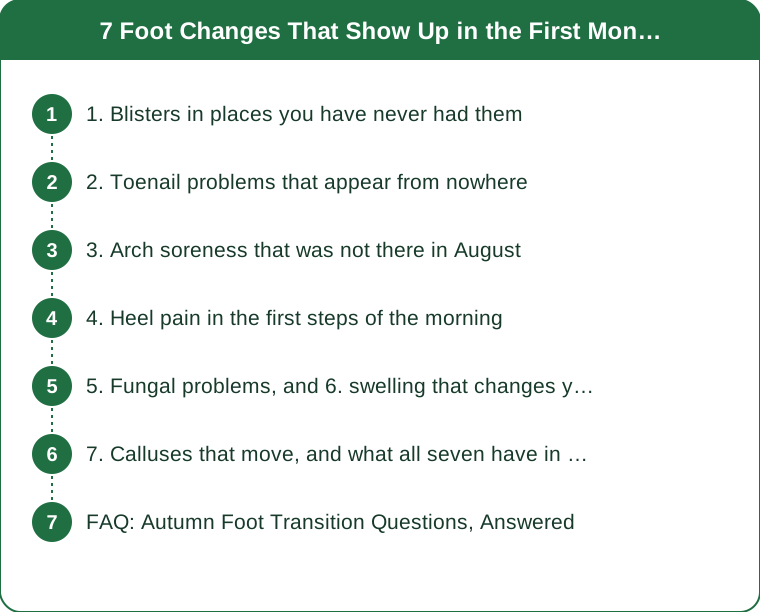
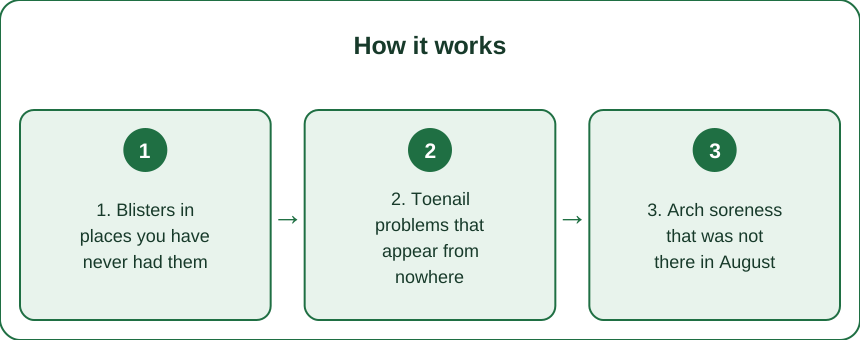
1. Blisters in places you have never had them
New friction points appear because the contact map has completely changed.
Sandals contact the foot at a handful of strap points and leave the rest open. A closed shoe contacts the entire foot surface, which means every seam, every stitch line and every internal edge is now touching skin that has had a summer off.
The most common new locations:
- The back of the heel, where a firm heel counter meets skin that has had no contact all summer
- The little toe, particularly in narrower autumn shoes
- The top of the toes, where a lower toe box now presses
Why it happens now rather than in July: skin toughens in response to repeated friction, and summer removed the stimulus at those specific points. The skin is not weaker overall - it is unconditioned in the places that are suddenly in contact.
What actually helps:
- Reintroduce closed shoes gradually if you can - a few hours a day for the first week
- Wool or synthetic socks rather than cotton, since damp skin blisters far more readily
- Address hot spots the moment you feel them rather than at the end of the day. A hot spot is a blister that has not formed yet, and tape at that point prevents it entirely
Expect this to settle within two to three weeks as the skin adapts. Blisters that keep recurring in the same place after a month are a fit problem, not a transition problem.
2. Toenail problems that appear from nowhere
Nails grew in open shoes and are now meeting the front of a closed one.
Toenails typically get trimmed less carefully in summer because there is more room, and sandals do not punish a longer nail. A closed shoe does, and the pressure at the nail edge produces soreness, bruising under the nail, or ingrown edges.
Three specific things go wrong:
- Bruising under the nail from repeated contact with the toe box, which usually means the shoe is too short for the way you actually move
- Ingrown edges, made worse by rounded rather than straight-across trimming
- Thickening or discolouration, which is a different problem and covered below
What to do in week one of the changeover:
- Trim nails straight across and not too short, which reduces ingrown risk substantially
- Check shoe length with a thumb-width of space in front of the longest toe while standing
- Note that the longest toe is not always the big toe - a longer second toe changes the fit requirement entirely
Bruising under the nail after a downhill walk or a run is common and usually resolves, though the nail may take months to grow out. Repeated bruising means the shoe is too small in length for the activity, and going up a half size for athletic shoes specifically is the standard fix.
3. Arch soreness that was not there in August
Sandals and closed shoes ask completely different things of the arch.
Flat sandals and barefoot time let the foot’s own structures do the work. A closed shoe with structured support does some of that work for you - and the transition in either direction produces soreness for a couple of weeks.
Which direction matters:
- Going from flat sandals into supportive shoes: the foot adapts to the new support geometry, and mild arch soreness for one to two weeks is normal
- Going from supportive summer shoes into flatter autumn ones - or into barefoot-style shoes - loads the intrinsic foot muscles more, and this one is worth taking slowly
The second one causes more problems, because it is genuinely a strength demand rather than an adaptation of position. Any move toward less support should be phased in over weeks rather than adopted for a full day.
What helps in either direction:
- Short foot strengthening - toe spreading, arch lifts, towel scrunches - a few minutes most days
- Alternating shoes rather than wearing one pair every day, which spreads the adaptation
- Gradual increase in time, particularly with any new support geometry
When it is not a transition effect: soreness that is sharp rather than achy, localised rather than general, or that gets worse over a month rather than better. That warrants a look from a professional rather than more stretching.

4. Heel pain in the first steps of the morning
The classic pattern, and the one on this list most worth acting on early.
Pain under the heel that is worst in the first few steps after getting up, eases with movement, and returns after sitting is a recognisable pattern associated with plantar fascia irritation.
Why the shoe changeover triggers it: the tissue adapted over the summer to one loading pattern - often flatter, more open shoes - and a sudden change in heel height, support geometry or activity level changes the load. Autumn also usually means more walking volume as routines restart.
What tends to help early:
- Calf stretching, since calf tightness increases tension through the tissue
- Avoiding completely flat shoes during a flare, and avoiding barefoot on hard floors first thing
- Reducing the sudden jump in walking volume rather than pushing through
- A gradual rather than abrupt shoe change
Why it matters to act early: this pattern responds well to early intervention and becomes considerably more stubborn once it has been present for months. The instinct to wait and see is the wrong one here.
See someone if it persists beyond a few weeks of sensible management, or if it is severe enough to change how you walk. This is one of the two things on this list worth a professional opinion rather than patience.
5. Fungal problems, and 6. swelling that changes your fit
Two things that follow directly from closed shoes as a physical environment.
### 5. Moisture and fungal issues
A closed shoe is warm, dark and damp - the exact conditions fungal organisms prefer. Summer sandals provided none of that, which is why athlete’s foot and nail fungus so often reappear in autumn.
Signs worth catching early: itching between the toes, peeling or cracked skin at the toe webs, and nail discolouration or thickening.
What actually reduces the risk:
- Rotating shoes so each pair dries fully - this is the single most effective habit, and 24 hours is the target
- Moisture-wicking socks rather than cotton, changed if they get wet
- Drying between the toes properly after showering, which is the step most people skip
- Not going barefoot in shared changing rooms
Treat early rather than waiting. Skin infections respond well to over-the-counter antifungals; nail involvement is considerably harder and slower, so the timing of action matters a lot.
### 6. Swelling that changes the fit
Feet swell across a day, and closed shoes make the effect visible in a way sandals do not. A shoe bought in the morning can be tight by evening, and this catches people out every autumn.
What to do: buy shoes later in the day, leave a thumb-width in front of the longest toe standing, and use lacing to accommodate rather than sizing up in length. A shoe too long slides and creates heel blisters, so length is not the right variable to adjust.
7. Calluses that move, and what all seven have in common
The pressure map changed, so the callus map follows it.
Calluses form where repeated pressure and friction occur, so summer builds them where sandal straps and open contact points sat - often the heel edge and the ball of the foot.
Closed shoes move the pressure, and within a few weeks the summer calluses soften while new ones start forming elsewhere. The heel callus that cracked all summer often improves in autumn, which is one of the few pleasant items on this list.
Where new ones appear: the ball of the foot under the second and third toes, the outside edge, and the back of the heel if there is friction there.
What is worth doing:
- File gradually rather than aggressively. A callus is a protective response, and removing it entirely means the pressure now lands on unprotected skin
- Moisturise the heel, particularly if summer cracking is still present
- Treat a callus that appears in one specific spot as information about fit, because that is what it is
### What all seven have in common
Five of these are transition effects that resolve in two to four weeks with a gradual changeover. Blisters, arch soreness, callus migration, mild swelling and nail sensitivity all settle as the foot adapts.
Two are not, and are worth acting on rather than waiting out: heel pain with the first-steps-in-the-morning pattern, which becomes more stubborn the longer it is left, and fungal involvement of the nails, which gets substantially harder to treat once established.
And the single change that prevents most of the list: do not switch abruptly. Two weeks of increasing closed-shoe time, with two pairs in rotation, avoids most of what is described above.
FAQ: Autumn Foot Transition Questions, Answered
How long should the changeover take?
About two weeks of gradually increasing closed-shoe time is enough for most people. Going straight from sandals to ten-hour days in boots is what produces the blister-and-soreness cluster in week one.
Why do my feet smell more in autumn?
Closed shoes trap moisture, and bacteria on the skin metabolise sweat in that environment. Rotating shoes so each pair dries fully for 24 hours, and using wool or synthetic socks rather than cotton, addresses most of it.
Should I go up a size in autumn shoes?
Check length with a thumb-width in front of the longest toe while standing, rather than assuming. Often the need is more width rather than more length, and a shoe that is too long causes heel slipping and blisters of its own.
Is morning heel pain serious?
It is the pattern most worth acting on early, because it responds well at first and becomes stubborn if left for months. Start with calf stretching, avoid flat shoes and hard floors first thing, and see someone if it persists beyond a few weeks.
Do I need to keep doing barefoot time in autumn?
It is worth keeping some, since closed shoes reduce the work your foot’s own structures do. A few minutes of barefoot movement at home most days maintains what the summer built.
Why do my old shoes feel different this year?
Either the shoe has changed - midsole and support materials degrade with age and storage - or your feet have. Both are common, and a pair that sat in a cupboard all summer is often past its useful life without looking it.
TL;DR:
- The closed-shoe changeover alters friction points, moisture, pressure map and support geometry all at once
- Blisters, arch soreness, callus migration and nail sensitivity are transition effects that settle in two to four weeks
- Morning heel pain and nail fungus are the two worth acting on early rather than waiting out
- Rotate two pairs so each dries fully for 24 hours - the single most useful habit of the season
- Wool or synthetic socks, not cotton; dry between the toes properly
- Check length with a thumb-width standing, and adjust fit with lacing rather than sizing up
Phase the changeover over two weeks and five of these seven never show up.
Keep Reading
This article is for general informational purposes only and is not medical advice. Always consult a qualified health professional for guidance specific to you.