7 Foot Problems That Show Up at the End of Summer
Quick Answer: Most late-summer foot complaints come from three months of flat, unsupported sandals followed by an abrupt return to closed shoes. Heel pain, arch soreness, cracked heels, and blisters in new places all spike in the last weeks of August for this reason. The fix is a two-week transition back into supportive shoes rather than a single-day switch.
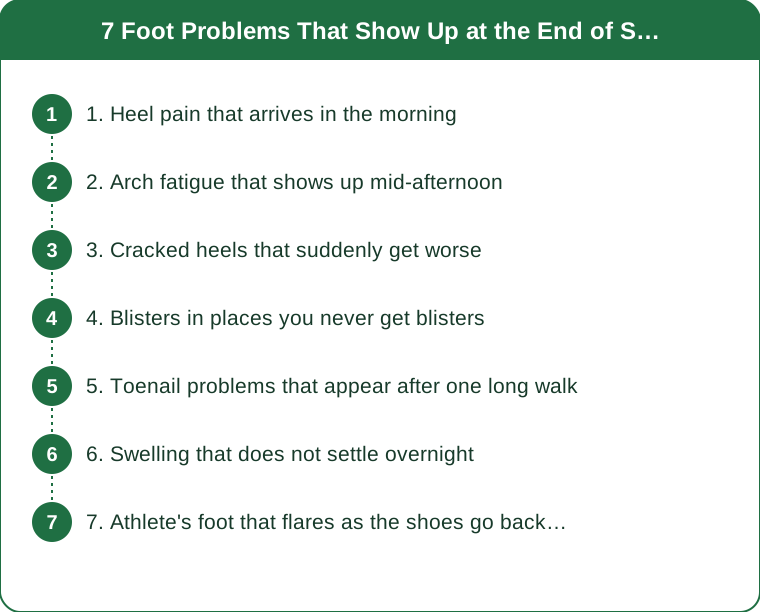
Podiatry clinics have a September rush, and it is not a coincidence. Here are the seven that show up most, in the order they tend to appear.

1. Heel pain that arrives in the morning
What it feels like: sharp pain in the heel for the first ten to twenty steps after getting out of bed, easing as you move, returning after you sit for a while.
Why now: three months of flat sandals means the plantar fascia has been working at full stretch with no arch support and no heel cushioning. The tissue accumulates micro-irritation slowly, and it usually announces itself around week ten to twelve — which lands in late August.
What helps: stop walking barefoot on hard floors first thing. Keep a supportive pair of shoes by the bed. Roll the arch on a chilled bottle for two minutes morning and evening, and stretch the calf properly — a tight calf loads the fascia every step. Improvement is usually measured in weeks rather than days, and pain that persists beyond a month or wakes you at night deserves a professional assessment.
2. Arch fatigue that shows up mid-afternoon
What it feels like: not sharp pain, just a deep ache through the middle of the foot by 3pm, worst on days you were on your feet.
Why now: unsupported footwear shifts the work from the shoe’s structure to your own foot muscles. They cope for a while. By the end of a summer they are simply tired.
What helps: rotate two pairs of shoes rather than wearing one, because different shoes load the foot slightly differently. Add short foot strengthening — press the ball of the foot down and draw the arch up without curling the toes, ten slow reps a side, twice daily. Most people notice a difference in about three weeks, and the strength carries into winter.
3. Cracked heels that suddenly get worse
What it feels like: the fissures that were cosmetic in July start catching on socks and occasionally bleeding.
Why now: open-backed sandals let the heel fat pad spread sideways on every step, and the skin thickens in response. Combine that with dry late-summer air and the callus splits rather than flexes.
What helps: soak, file gently with a foot file rather than a blade, and apply a urea-based cream — 10-25% urea is far more effective than a standard moisturiser because it breaks down the thickened keratin rather than just sitting on it. Apply at night and wear socks. Closed-back shoes accelerate the recovery considerably.

4. Blisters in places you never get blisters
What it feels like: a hot spot on the back of the heel or the side of the little toe within an hour of putting closed shoes back on.
Why now: skin that has been open to the air for three months is softer and less conditioned than skin that has been in shoes. Your feet have also usually gone up a fraction in volume through the summer from heat swelling.
What helps: reintroduce closed shoes gradually — two hours a day for the first week. Tape the known hot spots before the shoe goes on rather than after the blister forms. And re-check your shoe size in the late afternoon, because a shoe that fit in May may genuinely be tight now.
5. Toenail problems that appear after one long walk
What it feels like: a dark or tender nail, usually the second toe, a day or two after the first proper walk in trainers.
Why now: sandals never load the toe box. The first long walk back in closed shoes delivers three months’ worth of unfamiliar impact to the front of the nail in a single session.
What helps: cut nails straight across and short before the first long walk of the season. Lace shoes using the top eyelet properly so the foot does not slide forward on descents. A bruised nail is usually just a wait; one that is increasingly painful, spreading, or discharging needs to be seen.
6. Swelling that does not settle overnight
What it feels like: socks leaving deep marks, shoes feeling tight by evening, both feet affected roughly equally.
Why now: heat causes vasodilation, and a summer of warm days plus more sitting on holiday and in transit produces mild fluid pooling. It usually resolves as the weather cools.
What helps: elevate for fifteen minutes in the evening, move the ankles regularly on long sits, and keep hydration up — dehydration makes fluid retention worse rather than better. One caution: swelling in one foot only, or swelling with calf pain, redness, or breathlessness, is a different matter and needs urgent medical attention rather than a home remedy.
7. Athlete’s foot that flares as the shoes go back on
What it feels like: itching and peeling between the fourth and fifth toes, sometimes with a dry scaling on the sole.
Why now: the fungus is often present through summer without symptoms because sandals keep the skin dry. Closed shoes restore the warm, humid environment it needs.
What helps: treat with an over-the-counter antifungal for the full course on the label, which is usually a week or two longer than it takes symptoms to disappear — stopping early is the main reason it returns. Dry thoroughly between the toes, rotate shoes so each pair gets a day to dry out, and wash socks hot. If it does not respond within a few weeks, or the nails are involved, see a professional. This is general information, not medical advice.
TL;DR:
- The September foot rush is caused by three months of flat sandals meeting an abrupt return to closed shoes.
- Transition over two weeks rather than one day — a few hours in closed shoes at a time.
- Heel and arch pain respond to calf stretching, arch rolling, and short-foot strengthening, over weeks not days.
- Re-measure your shoe size in the late afternoon; summer feet are often genuinely larger.
- One-sided swelling, night pain, or anything spreading and worsening is a reason to see someone rather than to keep filing and stretching.
Almost all of these are transition problems, which means they are preventable next year by making the transition slower rather than by buying anything.
Keep Reading
This article is for general informational purposes only and is not medical advice. Always consult a qualified health professional for guidance specific to you.