7 Foot Problems That Show Up Right When Sandal Season Ends
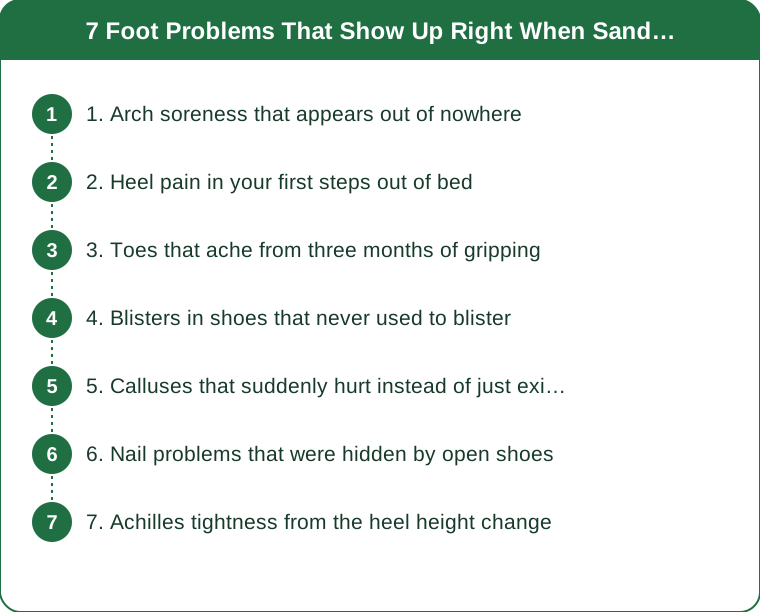
Quick Answer: Summer footwear — flat sandals, flip-flops, and going barefoot — changes how your feet load and which muscles work. When you switch back to closed, structured shoes, seven predictable problems appear: arch soreness, heel pain in the first steps of the morning, toe gripping fatigue, new blisters in old shoes, thickened calluses, nail issues, and Achilles tightness. Most resolve in two to three weeks with a gradual transition rather than an abrupt one.
You get through an entire summer with no foot complaints. Then the weather turns, you put on real shoes for a full day, and by Thursday something hurts that has never hurt before.
The shoes did not cause it. They revealed it.

1. Arch soreness that appears out of nowhere
What is happening: flat summer shoes give your arch no external support, so the muscles and plantar fascia do all the work themselves. Over three months, your foot adapts to that — the intrinsic muscles get stronger and the loading pattern shifts.
Then you put on a structured shoe with real arch support, and the support takes over work your foot had been doing. That sounds like relief and it often feels like soreness, because the loading pattern changes abruptly and tissues that were working one way are suddenly working another.
It also runs the other direction. If your summer was mostly barefoot and your autumn shoe is stiff and elevated, the arch is now held in a position it has not been in since May.
What to do: transition over ten days rather than in one day. Wear the closed shoes for half days at first. Soreness that improves week over week is adaptation; soreness that worsens is not, and the second one is worth a professional look.
2. Heel pain in your first steps out of bed
What is happening: this specific pattern — sharp heel pain in the first few steps of the morning that eases after walking — is the classic presentation of plantar fascia irritation.
Summer is when it develops, because flat, unsupportive shoes plus more barefoot time plus more walking is exactly the combination that overloads the fascia. The symptoms often lag the cause by weeks, which is why it announces itself in September rather than July.
What to do: calf stretching morning and evening, a gradual return to structured shoes, and avoiding a hard barefoot start on tile floors first thing. Rolling the arch over a frozen water bottle for five minutes in the evening is old advice that works.
When to escalate: heel pain that persists beyond three or four weeks of self-care, or that is severe enough to change how you walk, warrants a visit to a podiatrist or physical therapist. This is general information, not medical advice.
3. Toes that ache from three months of gripping
What is happening: flip-flops and backless sandals stay on your foot because your toes grip them. Every step, all summer. This is a real muscular workload that most people never consciously notice — the flexor muscles of the toes have been working overtime since June.
When you switch to closed shoes, the gripping stops abruptly. Sometimes the muscles simply ache from the change. Sometimes the habit persists and your toes keep gripping inside a shoe that does not need it, which causes cramping and top-of-foot fatigue.
What to do: toe extension work — spreading the toes wide and holding for five seconds, ten times a day — releases the pattern faster than anything else. Toe spacers for twenty minutes in the evening help for the same reason.
The prevention note for next year: backless sandals for short distances are fine. For a full day of walking, a strapped sandal that stays on without gripping is a meaningfully different experience for your feet.

4. Blisters in shoes that never used to blister
What is happening: two changes at once. Your feet spread slightly with sustained barefoot and flat-shoe time, and the skin that was exposed all summer is softer and less accustomed to friction in specific spots.
So last autumn’s shoes now sit fractionally differently, and the friction points have moved. Blisters in a broken-in shoe are almost always a fit change, not a shoe change.
What to do: socks first — many people go three months without wearing any and then put a bare foot into a closed shoe. Moisture-wicking socks eliminate a large share of these blisters immediately. Then check the fit; feet genuinely do get slightly wider over years and a size that fit in March can be tight in September.
Worth knowing: feet swell measurably through the day, and the traditional advice to shoe-shop in the afternoon exists for exactly this reason.
5. Calluses that suddenly hurt instead of just existing
What is happening: barefoot summer time thickens calluses, particularly on the heel and the ball of the foot. Thick callus is protective when the pressure is spread across a flat surface.
Inside a closed shoe, pressure concentrates differently, and a thick callus stops being padding and starts being a hard object pressed into soft tissue underneath it. That is why a callus you did not notice in July becomes tender in September.
What to do: reduce gradually rather than aggressively. Soak, then use a pumice or foot file a little at a time over several days, and moisturize. Do not cut calluses with a blade, and be cautious with medicated callus removers, which do not distinguish between callus and healthy skin.
If you have diabetes or any condition affecting circulation or sensation in your feet, do not self-treat calluses at all — this is genuinely a case for professional care.
6. Nail problems that were hidden by open shoes
What is happening: all summer, your nails had air, light, and no pressure from a toe box. Closed shoes reverse all three.
Two things surface. Ingrown edges that were tolerable in sandals become painful when a shoe presses the toe from the side. And fungal issues that were dormant or unnoticed find the warm, dark, humid environment of a closed shoe extremely agreeable.
What to do: cut nails straight across rather than curved, which is the single biggest factor in ingrown edges. Rotate shoes so each pair dries fully for 24 hours between wears — this one habit does more for foot fungus prevention than any product. Change socks if your feet sweat heavily during the day.
Persistent nail discoloration or thickening is worth having looked at, because over-the-counter treatments for nail fungus have a genuinely poor success rate and the correct diagnosis matters.
7. Achilles tightness from the heel height change
What is happening: if your summer was flat sandals and your autumn shoe has any heel drop at all — most sneakers have 8 to 12mm, boots often more — your Achilles and calf have spent three months at one length and are now being asked to work at another.
The reverse is worse and more common than people think: going from summer sandals with a slight wedge straight into flat shoes puts the Achilles under more stretch than it has handled in months.
What to do: phase it. Alternate between old and new footwear for the first week or two. Calf stretching, both straight-knee and bent-knee, addresses the two different structures involved.
The warning sign: Achilles pain that is worse in the morning and worse at the start of activity, rather than during it, is worth taking seriously and worth not training through. Achilles tendon problems are far easier to prevent than to resolve.
The overall pattern across all seven: feet adapt to what you ask of them, and every seasonal footwear change is a request to adapt again. Two weeks of overlap between summer and autumn shoes prevents most of this list.
TL;DR: Seven predictable problems arrive when summer footwear ends, and almost all of them are transition problems rather than injuries.
- Arch soreness and heel pain come from three months of unsupported loading. Improve gradually; worsening is a red flag.
- Toe ache is real muscular fatigue from gripping flip-flops all summer. Toe extension work releases it.
- New blisters in old shoes usually mean your feet spread slightly — and that you stopped wearing socks in June.
- Calluses stop being padding once pressure concentrates inside a closed shoe. Reduce slowly, never with a blade.
- Nail problems surface because closed shoes are warm and dark. Rotate shoes so each pair dries 24 hours.
- Achilles tightness follows any heel-height change in either direction.
Overlap your summer and autumn shoes for two weeks instead of switching in one day. That single change prevents most of this list.
Keep Reading
This article is for general informational purposes only and is not medical advice. Always consult a qualified health professional for guidance specific to you.