7 Signs the Problem Is Your Sock, Not Your Shoe
Quick Answer: A sock changes effective shoe volume, moisture management and friction — three of the four things that cause foot problems. Before replacing shoes, check for these seven signs. Blisters in a consistent spot, numbness that appears mid-session, and problems that started when the weather changed are the three most likely to be sock-caused, and all three are fixable for under ten dollars.
People spend a hundred and fifty dollars solving a two dollar problem constantly.
A sock sits between your foot and the shoe, and it controls thickness, friction, moisture and grip. When something goes wrong down there, it is genuinely more likely to be the cheap layer than the expensive one.

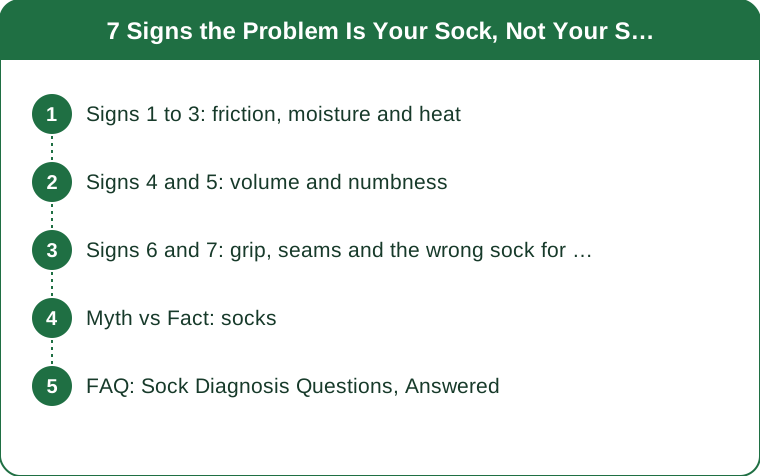
Signs 1 to 3: friction, moisture and heat
1. Blisters in the same spot every time
A blister is a shear injury — skin sliding against skin under pressure with moisture present. If it appears reliably in one location, the question is whether that location correlates with a shoe seam or with a sock feature.
The tell: take the sock off and look at it. If there is a seam, a heel-turn line, or a logo directly over the blister site, the sock is your culprit. Cotton socks are the single biggest cause here — cotton holds roughly seven percent of its weight in water without feeling wet, then far more, and wet skin blisters at dramatically lower shear forces than dry skin.
2. Feet soaked after a moderate session
If your feet are wet after a walk that should not have produced that, look at fibre before assuming you sweat heavily. Cotton absorbs and holds. Merino wool and synthetic blends move moisture outward and keep the skin surface drier at the same sweat rate.
The test: wear a merino or synthetic pair for the same activity. If the difference is dramatic, it was never a sweating problem.
3. Hot spots that appear at a predictable time
A burning sensation that reliably shows up at the twenty-minute mark is friction building, not a shoe that suddenly stopped fitting. Sock bunching is the usual mechanism, and bunching is a fit problem — a sock slightly too large wrinkles under the arch or at the heel and creates a ridge that rubs.
The check: at the moment the hot spot appears, stop and feel for a fold. It is usually there.
Signs 4 and 5: volume and numbness
4. Numbness or tingling that appears mid-session
This one is frequently blamed on shoes being too narrow, and often the shoe was fine until the sock changed.
A sock adds volume inside the shoe. A thick winter sock can add 2 to 4mm across the top of the foot, which on a shoe that fit closely is enough to compress nerves across the top and produce numbness in the toes. Foot swelling during activity — normal, and up to half a size over a long session — stacks with it.
The tell: the numbness appears fifteen to thirty minutes in, rather than immediately. An immediately too-small shoe hurts from the first step. A volume problem takes time to develop, because it needs swelling to complete it.
The fix: thinner socks, or loosening the lacing over the instep. Both are free. Buying wider shoes for what is actually a volume problem does not usually help, because width and height are different dimensions.
5. The problem started when the weather turned
This is the most diagnostic sign on the list and the most overlooked. If your shoes were fine in July and are uncomfortable now, and you have swapped from thin summer socks to thicker autumn ones, the sock changed and the shoe did not.
The first month of closed shoes and proper socks is when this shows up. People conclude their shoes have worn out or their feet have changed. Almost always it is 2 to 4mm of extra sock.
The test: wear your summer sock in the same shoe for one session. If the problem disappears, you have your answer, and it cost nothing to find.

Signs 6 and 7: grip, seams and the wrong sock for the job
6. Your foot slides forward, or your heel lifts
Heel lift and forward slide are usually attributed to shoe fit, and sock material has a large effect on both. A slick synthetic sock with a smooth surface allows the foot to move inside the shoe in a way a wool or textured cotton-blend does not.
This matters most going downhill and on stairs, where forward slide bruises toenails. If you are losing toenails and your shoes have half a thumb of room, look at whether the sock is letting your foot move rather than assuming the shoe is too big.
The fix: a sock with more surface texture, or a proper heel-turn construction — a sock shaped with a defined heel pocket rather than a tube. Tube socks are the worst offenders for slide and are still widely sold.
7. Toe pain, corns or nail problems in a shoe with room
A sock with a tight toe closure — the seam across the toes — can compress the toes even in a roomy shoe. Cheap socks often have a bulky, ridged toe seam that sits directly across the toe joints.
The tell: run a finger across the inside of the toe seam. If you can feel a substantial ridge, that ridge is pressing into your toes for every step of every mile. Seamless or hand-linked toe socks exist specifically for this and cost a few dollars more.
The other version of this: socks that are simply too short in the foot, pulling the toes back into a slightly curled position. Common when socks shrink, and common when the size range is broad — a sock labelled for sizes 6 to 10 fits one of those sizes well.
Myth vs Fact: socks
Myth: Thicker socks mean more cushioning and fewer problems. Fact: Thicker socks mean more volume, and volume is the most common sock-caused problem. Cushioning belongs in the shoe. A thick sock in a snug shoe creates compression, restricts circulation and increases heat.
Myth: Cotton is the natural, breathable choice. Fact: Cotton is the worst common fibre for active feet. It absorbs, holds moisture against the skin, loses all insulating value when wet, and dramatically increases blister risk. Merino manages moisture and temperature far better and resists odour; synthetics dry fastest.
Myth: Double socks prevent blisters. Fact: The theory is that the two layers slide against each other rather than against skin, and it does work for some people. It also adds substantial volume, which causes the problems in signs 4 and 5. Purpose-made double-layer socks are a better answer than two ordinary pairs.
Myth: Sock choice does not matter for walking, only for running. Fact: Total step count matters more than intensity for friction injuries, and a day of walking easily exceeds a run in steps. Long travel days and standing days are where sock choice shows up most.
Myth: Expensive socks are a con. Fact: This is one of the few areas where the price gap buys something concrete — fibre quality, seam construction, a shaped heel and graduated thickness. A $15 technical sock genuinely outperforms a $2 one, and it is still the cheapest component in the system.
FAQ: Sock Diagnosis Questions, Answered
How do I test whether it is the sock or the shoe?
Swap one variable at a time. Same shoe, different sock, same route. If the problem changes, it was the sock. This takes one session and costs nothing, and most people skip straight to buying shoes instead.
How often should socks be replaced?
When the elasticity goes, which is usually 6 to 12 months of regular rotation. A sock that no longer grips the arch or the ankle will bunch, and a bunched sock is a blister. Thinning at the heel or ball is a clear replacement signal.
Should workout socks and daily socks be different?
Usually yes. Activity socks need moisture management, a shaped heel and minimal seams. Daily socks in a roomy shoe can be almost anything. The overlap problem is people wearing daily socks for activity, not the reverse.
What about compression socks?
Useful for swelling, long travel and some recovery contexts. They add volume, so shoe fit needs checking with them on. Graduated compression should be firmest at the ankle; if it is tightest at the calf, it is a sock with a tight band rather than a compression garment.
Does sock height matter?
For shoe interaction, mainly at the heel — a sock that sits below the shoe collar lets the collar contact skin, which is the classic no-show sock blister. Otherwise height is preference.
My feet still hurt after fixing all of this. Now what?
Then it probably is the shoe, or the foot. Persistent pain, numbness that does not resolve, or pain that wakes you at night deserves assessment from a podiatrist or doctor rather than another round of gear changes.
This is general information, not medical advice.
TL;DR:
- A sock controls volume, friction, moisture and grip — four of the main causes of foot problems.
- Blisters at a fixed spot, mid-session numbness, and problems that began when the weather turned are the three strongest sock signals.
- A thick autumn sock adds 2 to 4mm — enough to change a shoe that fit perfectly in summer.
- Cotton is the single worst common choice. Merino or synthetic, with a shaped heel and a flat toe seam.
- Swap one variable at a time: same shoe, different sock, same route.
Before you replace shoes, spend fifteen dollars and one session testing the cheapest layer in the system. It is right a surprising amount of the time.
Keep Reading
This article is for general informational purposes only and is not medical advice. Always consult a qualified health professional for guidance specific to you.