7 Signs Your Foot Pain Is Actually Coming From Higher Up
Quick Answer: Foot pain that has not responded to shoes, insoles, and stretching for more than six weeks is worth investigating further up the chain. The strongest signals are pain that switches location, calf tightness that returns within days of stretching, one-sided symptoms with a one-sided hip weakness, and any numbness or tingling that follows a line rather than sitting in one spot. The foot is the end of a chain, and the end of a chain is where the symptoms of a problem elsewhere often show up.
Most people work downward. New shoes, then better insoles, then a night splint, then a different pair of shoes. When six weeks of that has not moved anything, the useful question is whether the foot is the site of the problem or just the site of the pain.

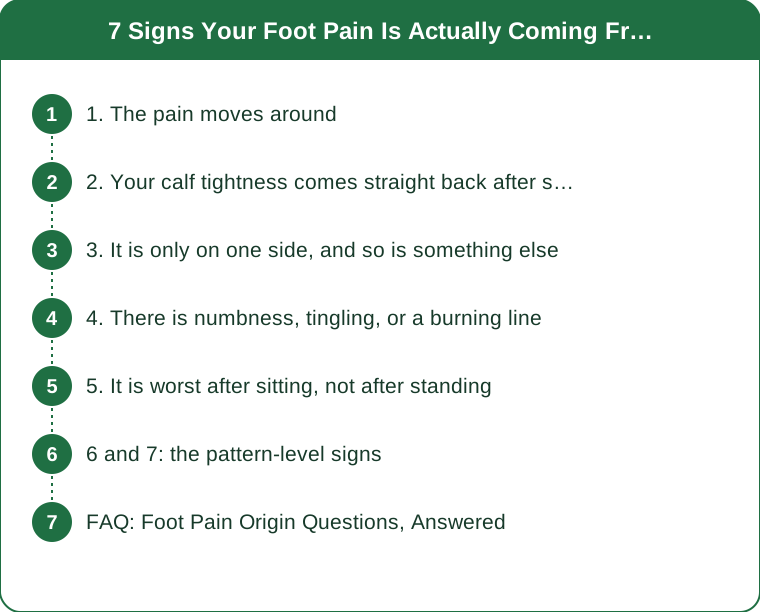
1. The pain moves around
This is the single most informative sign, and it is easy to dismiss because it feels like the problem is getting better and worse randomly.
A structural foot problem - a stress reaction, a genuine plantar fascia injury, a neuroma - stays in one place. You can put a finger on it, and the finger goes to the same spot every week.
Pain that migrates - heel one week, arch the next, outside of the foot the week after - usually indicates a loading problem rather than a tissue problem. Something further up is changing how force goes through the foot, and the tissue that complains is simply whichever one is currently taking the most of it.
The test: for two weeks, mark on a simple foot outline exactly where it hurt each day. If the marks spread across the page, look upward. If they stack in one spot, the foot is likely the actual site.
A related version: pain that changes with which shoes you wear but never fully goes in any of them. That is also a loading signature rather than a tissue one.
2. Your calf tightness comes straight back after stretching
Calf tightness is the most common driver of heel pain, and the pattern of its return tells you where it is coming from.
A genuinely short calf muscle responds to consistent stretching. Range improves gradually over four to six weeks and holds between sessions.
A calf that feels loose right after stretching and tight again by the next morning is usually not short - it is protectively toned. Something is making the nervous system hold tension there, and the usual candidates are a weak glute on the same side, an unstable ankle, or a lower back issue.
The specific test: the weight-bearing lunge test. Face a wall, foot flat, knee driving forward over the toes. Most people should reach roughly 10cm from wall to big toe without the heel lifting. If you are well short of that on one side only, and it does not improve over weeks of stretching, the restriction is probably not the muscle itself.
What actually helps: strengthening rather than stretching. Calf raises through full range, and single-leg work that gives the ankle a reason to feel stable.
3. It is only on one side, and so is something else
Truly one-sided foot pain in someone who walks and stands symmetrically deserves a look at asymmetry higher up.
Check three things.
Single-leg balance. Stand on one leg, eyes open, for 30 seconds. Then the other. A clear difference points at hip stability rather than foot mechanics.
Single-leg sit-to-stand. From a chair, one leg. Compare sides. A weak side here is a glute and quad story, and a weak hip on one side changes how that foot lands on every step.
Shoe wear pattern. Line up your two most-worn pairs and compare soles. Distinctly different wear patterns between left and right - not just more wear, but a different shape of wear - means the two legs are doing different jobs.
The reason this matters: the hip abductors control how much the knee falls inward during stance, and that directly determines how much the foot has to pronate to compensate. Weak hip, more pronation, more strain through the arch and the fascia. Insoles manage the symptom; the hip is the cause.

4. There is numbness, tingling, or a burning line
This is the sign that most changes what you should do next.
Local foot problems produce local symptoms: aching, sharpness on pressure, pain on first steps. Nerve involvement produces numbness, pins and needles, burning, or electric sensations, and these tend to follow a line or a defined patch rather than a diffuse area.
The common sources are further up. Nerve irritation at the lower back can refer symptoms down the leg into the foot. Entrapment behind the inner ankle produces burning in the sole. Compression at the outer knee affects the top of the foot and the ability to lift it.
The pattern worth noticing: symptoms that change with your back or hip position rather than with your foot. If sitting for a long time, or bending forward, or a particular sleeping position reliably changes the foot symptoms, the foot is not driving it.
This is the one to get assessed rather than manage at home. Numbness, weakness, or symptoms in both feet are worth a proper examination rather than a new insole. This is general information, not medical advice.
5. It is worst after sitting, not after standing
The timing of your worst pain is genuinely diagnostic, and this specific pattern gets misread constantly.
Classic plantar fasciitis hurts most with the first steps in the morning and after long sitting, then eases with a few minutes of walking, then returns after a long day on your feet. That is a well-known pattern and it does point at the foot.
But there is a lookalike. Pain that appears specifically after prolonged sitting, does not follow the first-steps-in-the-morning pattern, and is accompanied by any stiffness in the low back or buttock, has a different likely origin. Prolonged hip flexion is the common thread, and the foot symptoms are downstream.
A useful distinguisher: on a day when you barely sit at all, does the foot feel better or worse? Foot-origin pain is usually worse on a heavy standing day. Referred pain is often better on the day you moved more and sat less, even if you were on your feet longer.
This is also why the problem often appears in September for office workers - the summer of walking ends and the sitting hours go back up.
6 and 7: the pattern-level signs
The last two are less about a specific sensation and more about the shape of the whole problem.
6. Nothing you have tried has changed it at all
Not partially. At all. Four different pairs of shoes, custom orthotics, six weeks of stretching, and the pain is identical.
A foot-origin problem almost always responds to something, even temporarily. A softer shoe helps a bit. A heel raise takes the edge off. Rest reduces it. Complete non-response to every foot-directed intervention is itself information - it suggests the input driving the symptom has not been touched by anything you have changed.
The useful move at this point is not another insole. It is a movement assessment that looks at the hip, the ankle, and the way you actually walk.
7. It started when something else changed - and the something else was not your shoes
Track backwards to the week it began. If the onset lines up with a new desk, a longer commute, a driving-heavy job, a new baby on one hip, a change in bed, or a back episode that resolved - and not with new shoes, new mileage, or a new surface - that is a strong pointer upward.
The classic version: foot pain that begins four to eight weeks after an unrelated back or hip problem seemed to settle. The original problem changed how you move, the movement change loaded the foot differently, and the foot took a month or two to complain about it.
FAQ: Foot Pain Origin Questions, Answered
How long should I try foot-based fixes before looking elsewhere?
About six weeks of consistent effort - the right shoes, daily calf and fascia work, and load management. If nothing has shifted at all in that time, widen the search.
Do orthotics stop working if the cause is higher up?
They often help initially and then plateau, because they change the foot’s position without changing the force arriving at it. A plateau after two or three good weeks is a common signature of an upstream cause.
What should I ask for at an appointment?
Ask for a movement assessment, not just a foot examination - specifically hip strength testing, ankle dorsiflexion range, and a look at single-leg control. Bring your two most-worn pairs of shoes; the wear pattern is genuinely useful data.
This is general information, not medical advice. Sudden severe pain, an inability to bear weight, numbness in both feet, or foot pain alongside back pain and any bladder or bowel change need prompt medical attention.
TL;DR:
- Pain that moves is a loading problem; pain that stays in one spot is usually a tissue problem.
- Calf tightness that returns overnight is protective tone, not a short muscle - strengthen rather than stretch.
- One-sided pain plus one-sided hip weakness is the most common upstream pattern.
- Numbness or a burning line means get it assessed rather than buy another insole.
- If six weeks of foot-directed fixes have changed nothing at all, that non-response is the clue.
The foot is the end of the chain, and the end of the chain is where a problem somewhere else usually announces itself. Six weeks is a fair trial. After that, look up.
Keep Reading
This article is for general informational purposes only and is not medical advice. Always consult a qualified health professional for guidance specific to you.