7 Things That Happen to Your Feet on a Long Travel Day
Quick Answer: On a long travel day your feet swell from pooled fluid, your arches fatigue from hard flat floors, cabin dryness cracks skin, immobility stiffens the ankle, shoes that fit in the morning compress by evening, altitude changes shoe pressure slightly, and the whole sequence leaves you with a next-day ache that is not injury. The countermeasures are unglamorous: move every hour, size shoes for the evening foot, hydrate, and pack one alternate pair.
None of this is serious in isolation. Together, on a 14-hour door-to-door day, they add up to feet that feel like they belong to someone else.

1. Fluid pools in your feet and ankles
The most noticeable change, and the one with the clearest mechanism.
What happens. Your calf muscle acts as a pump that pushes venous blood back toward the heart. Sitting still for hours switches that pump off, so fluid accumulates in the lower legs and feet under gravity. Cabin pressure and long periods with knees bent add to it.
How much. Measurable foot volume increases over several hours of seated travel are well documented, which is why shoes that fit at 7am are tight at 7pm.
What to do. Ankle circles and calf raises every hour, ten of each - the calf raises are doing the actual work. Walk the aisle or the terminal once an hour on a long day. Compression socks are genuinely effective for this and are one of the few travel products that reliably does what it claims.
What not to do. Take your shoes off for eight hours and expect them to go back on. They will not, and the struggle at the gate is a rite of passage nobody needs.
2. Your arches fatigue on flat, hard airport floors
Airports are miles of polished concrete, and you cover more of them than you think.
What happens. Terminal walking often runs one to three miles across a connection-heavy day, on a completely flat, unyielding surface. Your foot’s intrinsic muscles and plantar fascia handle repeated loading without any of the variation that natural ground provides.
The result is a specific arch ache that shows up in the second half of the day and is worst in the first steps the next morning - the classic pattern of plantar fascia irritation.
What to do. Wear a shoe with real cushioning and some arch support, not a flat fashion sneaker or a thin sandal. If you know you have a sensitive arch, this is the day to wear the supportive pair even if it does not match anything.
A useful trick: roll each foot over a cold water bottle for two minutes on arrival. It addresses both the fascia and the swelling at once.
3. Cabin air dries and cracks your skin
Aircraft cabin humidity typically runs very low - often under 20 percent, drier than most deserts.
What happens. Skin loses moisture to the air, and the thick skin on heels and the balls of the feet is where that shows first as roughness and, over repeated travel, as heel fissures.
Made worse by bare feet in cabin socks on a dry cabin floor, and by the friction of walking a lot in the same shoes.
What to do. Apply a thick emollient before the flight, wear socks over it, and reapply on arrival. A urea-based or lanolin foot cream is considerably more effective on thick skin than a standard body lotion.
Drink water, and understand what it does. Hydration helps overall but does not directly moisturize the outer skin layer - the topical barrier is what does that. Doing only one of the two is why people who drink plenty of water still arrive with rough heels.
4. Your ankle stiffens from a fixed position
Less discussed than swelling and arguably more responsible for how you feel walking off the plane.
What happens. Held at roughly the same angle for hours, the ankle joint loses some of its range of motion temporarily, and the calf and Achilles shorten slightly in that position. Joints also rely on movement to circulate synovial fluid, which sitting prevents.
The result is that first stiff, careful walk down the jet bridge, and a noticeably reduced push-off in your gait for the first several minutes.
What to do. Point and flex the foot 20 times per hour, and rotate the ankle in both directions. It takes 30 seconds and it directly addresses the mechanism.
On arrival, a calf stretch against a wall for 30 seconds per side before you walk any distance restores a lot of it. Skipping this and immediately walking a mile through an unfamiliar city is how a travel day becomes a sore Achilles.
5. Shoes that fit in the morning stop fitting by evening
This is a consequence of item 1, and it deserves its own treatment because it is where most travel foot pain actually comes from.
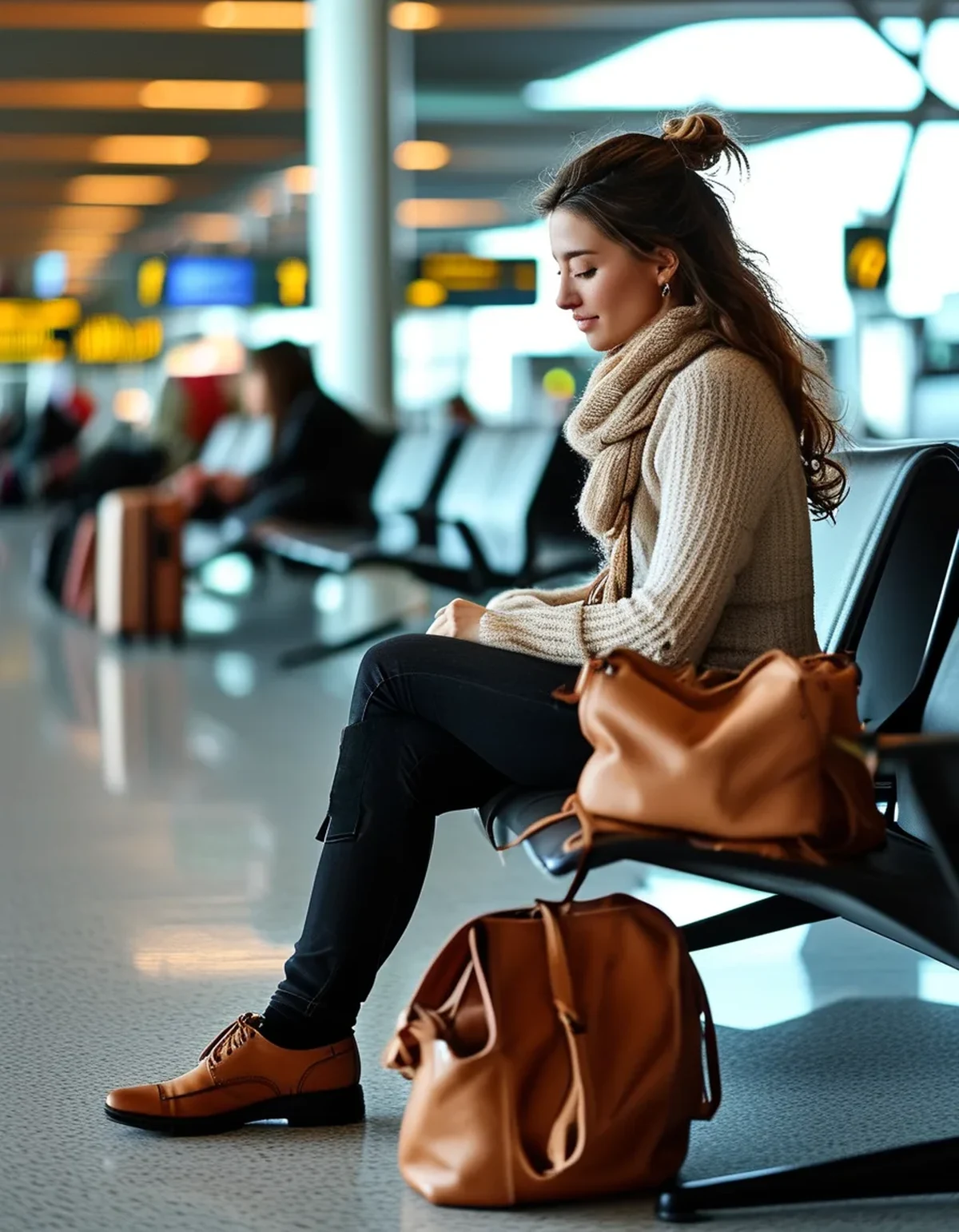
What happens. A shoe sized to a morning foot becomes a compression device on an evening foot. Compression causes numbness in the toes, blisters at pressure points, and toenail bruising - especially on any downhill walking with luggage.
What to do. Travel in shoes with a half size of room or with adjustable volume - laces you can loosen, straps you can let out. Slip-ons with a fixed upper are the worst option for a long day.
Loosen the laces preemptively two hours into a flight, before it becomes necessary. Reactive loosening happens after the pressure has already caused a problem.
Pack one alternate pair in the carry-on if the day is very long. A soft slip-on for the second half of a 14-hour day is a small amount of space for a large amount of relief.
6. Altitude and pressure change how tight things feel
A smaller effect than the internet suggests, and real enough to notice.
What happens. Cabin pressure at cruise is equivalent to roughly 6,000 to 8,000 feet of altitude. That mild reduction contributes modestly to fluid shifts, and gases in the body expand slightly, which some people perceive as puffiness.
The bigger factor is the combination. Reduced pressure plus immobility plus low humidity plus a fixed position for hours. Isolating any one of them understates the total.
What to do. The same interventions handle it: movement every hour, compression socks, hydration. There is no altitude-specific fix.
Worth knowing: the swelling from a single long flight typically resolves within about 24 hours. Swelling in one leg only, particularly with calf pain, warmth or redness, is a different matter and warrants prompt medical attention rather than a foot soak.
7. The next-day ache that is not an injury
You wake up the day after travel and your feet hurt in a way that feels alarming.
What happens. You combined unusual mileage on hard flat surfaces, hours of immobility, dehydration, and a shoe that got tight - then slept, during which the fascia and calf shortened further.
The tell that it is normal: it is worst in the first ten steps and eases as you move. Pain that increases with activity, or that is sharp and localized rather than diffuse, is a different signal.
What to do. Before getting out of bed, point and flex each foot 20 times and pull the toes back gently toward you for 30 seconds. Then walk on soft surfaces where possible for the first day, and keep the supportive shoes on rather than switching to flat sandals.
Elevate for 15 minutes at some point in that first day - legs above heart level does more for residual swelling than any amount of walking.
When to take it seriously. Pain that persists past a few days, one-sided calf swelling or pain, numbness that does not resolve, or any sharp localized heel pain that worsens over a week should be seen by a professional rather than walked off.
This is general information, not medical advice.
TL;DR:
- Long travel days cause foot swelling, arch fatigue, dry cracked skin, ankle stiffness, shoe compression, mild pressure effects and a next-day ache.
- Calf raises and ankle circles every hour address the swelling and stiffness mechanisms directly - compression socks genuinely work.
- Size shoes for the evening foot, choose adjustable volume, and loosen laces before it becomes necessary.
- Apply a thick foot cream before the flight and again on arrival; hydration alone does not fix skin.
- Next-day ache that eases as you move is normal; one-sided calf swelling or pain is not and needs medical attention.
Almost all of this is preventable with about four minutes of movement per hour and one better shoe decision. Which is a very good return for the amount of misery involved on the other side.
Keep Reading
This article is for general informational purposes only and is not medical advice. Always consult a qualified health professional for guidance specific to you.