7 Foot Problems That Appear the Week You Switch Out of Summer Shoes
Quick Answer: Moving from open summer shoes to closed autumn ones changes toe splay, arch support, heel drop and moisture all at once, and your feet have spent three months adapting to the opposite. The seven problems below - blisters, toe crowding, arch soreness, calf tightness, nail issues, athlete’s foot and heel pain - each trace to one of those four changes. The fix in almost every case is a two-week transition rather than a single-day switch.
The most useful single action: buy and fit new shoes in the afternoon, when your feet are at their largest.
This is general information rather than medical advice.

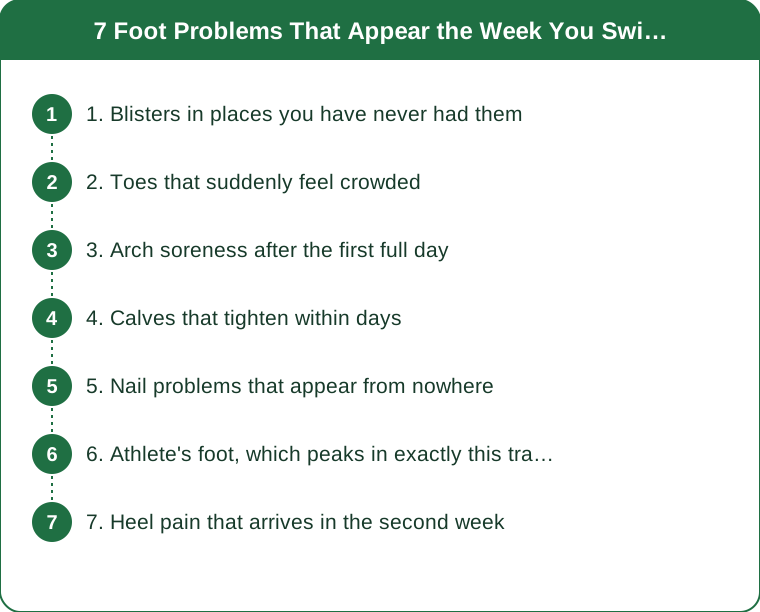
1. Blisters in places you have never had them
The most immediate problem, and it is a friction map change rather than a fit failure.
Why it happens now. Three months of sandals means the skin on your feet has thinned in areas that were not being loaded and thickened in areas that were. A closed shoe loads a completely different set of contact points against skin that has not been conditioned for it.
The common new locations:
- Back of the heel, which sandals barely touch
- The top of the toes, where a toe box makes contact
- The instep, under lacing pressure
What makes it worse in this season specifically. Late summer is still warm, so feet sweat inside a closed shoe for the first time in months. Damp skin blisters far more readily than dry skin - moisture is a bigger factor than friction alone.
What actually prevents it:
- Wear the closed shoes for 2 to 3 hours a day for the first week, not a full day. This conditions the skin gradually
- Socks, without exception, and not cotton ones. Wool or synthetic moves moisture; cotton holds it against the skin
- Tape hotspots before they blister. Once you feel a hot spot, the damage has started - a strip of tape at that point prevents the blister entirely
- Two pairs of socks on very long days, or double-layer socks, which move friction between the layers rather than against skin
If a blister forms. Leave intact blisters alone and cover them; the skin is the best dressing available. Only drain a blister if it is large and under pressure, and then leave the roof in place.
2. Toes that suddenly feel crowded
Your feet genuinely got wider over the summer, and a shoe that fit in May may not now.
What happens in sandals. Unrestricted toe splay over three months allows the forefoot to spread and the intrinsic foot muscles to work more. This is a good thing, and it is why the first closed shoe feels tight.
Feet also change size across a day and across years:
- Feet swell measurably through the day, which is why afternoon fitting is standard advice
- In heat, they swell more, so late-summer feet are at their largest
- Adult feet lengthen and widen slowly over decades, so a size held since your twenties is often wrong
The fit checks worth doing:
- A thumb’s width between the longest toe and the end, standing, weight on the foot. The longest toe is not always the big toe
- Toes should splay, not touch. If they are pressed together, the toe box is too narrow regardless of length
- The widest part of the foot must sit at the widest part of the shoe, which is a separate check from length
- Measure both feet. A half-size difference is common and you fit the larger one
Why crowding matters beyond comfort. Persistent forefoot compression contributes to bunion progression, neuromas and hammer toes over time. It is not just discomfort deferred.
What to do with shoes you already own. A wide toe box is not something a shoe stretch will fully create, but removing a thick insole often gains meaningful width and depth, and toe spacers worn at home preserve the splay you gained over summer.
3. Arch soreness after the first full day
A support change, and it runs in both directions depending on what you wore.
If you wore flat sandals all summer. Your arch has been working unsupported. A shoe with substantial arch support suddenly changes the load distribution, and the tissue adapts with some soreness - typically resolving within a week.
If you wore supportive sandals and switched to flat shoes. The reverse: the arch is now doing work it has not done in months, which is more likely to produce genuine soreness and takes longer to settle.
How to tell which you are dealing with:
- Soreness that improves as the day goes on usually means adapting to less support
- Soreness that worsens through the day and is worst at the end usually means too much load on tissue that is not ready
The transition protocol:
- Half days for the first week, alternating with the summer shoes
- Full days from week two, with the first long walk deferred to week three
- Calf and foot stretching morning and evening, since calf tightness directly increases arch strain
The distinction that matters clinically. Adaptation soreness is diffuse, worst after activity, and improves week to week. Plantar fasciitis is sharp, worst with the first steps in the morning, and improves briefly with movement before returning. The morning-first-step pattern is the key distinguishing feature and it warrants attention rather than pushing through.

4. Calves that tighten within days
A heel drop change, and it is the most common overlooked cause of autumn foot and leg pain.
What heel drop means. The height difference between the heel and forefoot of a shoe. Summer sandals are often close to zero drop; many closed shoes and trainers sit at 8 to 12mm.
What a change does. Heel drop determines the length the calf and Achilles operate at.
- Moving to a higher drop shortens the working length, and the calf adapts by tightening
- Moving to a lower drop lengthens it, which loads the Achilles more and is the direction more likely to cause injury
Why this matters more than it sounds. A 10mm change is large relative to the range these tissues work in, and switching your whole shoe rotation over a weekend applies it to every step you take.
The management:
- Check the drop of what you are moving between, which is usually published for trainers and rarely for other shoes. Look at the shoe from the side as a rough guide
- Alternate between old and new for two weeks rather than switching outright
- Calf stretching twice daily during the transition - both straight-knee for gastrocnemius and bent-knee for soleus, 30 seconds each
- Eccentric heel drops off a step, 3 sets of 10, if the Achilles feels loaded. This is the best-evidenced intervention for Achilles tissue
The warning sign. Achilles pain that is worst in the morning and eases with movement, especially after a shoe change, is early Achilles tendinopathy and should be addressed immediately rather than trained through. It responds well early and poorly late.
5. Nail problems that appear from nowhere
Closed shoes create contact that sandals never did, and the nail is where it shows.
The mechanisms:
- Repeated impact against the toe box, particularly walking downhill or stopping suddenly, causes bruising under the nail
- Pressure from a shallow toe box on the nail plate itself
- Moisture, which softens the nail and the surrounding skin
The specific problems:
- Bruised nails, dark under the plate. Usually the shoe is a half size too short or the lacing is not holding the foot back
- Ingrown toenails, which appear when a narrow toe box presses the nail edge into the skin fold. Also caused by cutting nails curved rather than straight across
- Thickened or discoloured nails, which after months of sandals can indicate fungal infection that was simply not noticed
Prevention:
- Cut nails straight across and not too short. Curved cutting is the leading cause of ingrown nails
- Check nail length before the shoe switch. Long nails in a closed shoe cause bruising immediately
- Heel-lock lacing for anything downhill - the extra loop at the top eyelet holds the heel back and stops the toes hitting the front
When to see a professional. Ingrown nails with redness, swelling or discharge, any nail change in someone with diabetes or reduced foot sensation, or a dark line under a nail that was not preceded by an injury - that last one should be looked at rather than watched.
6. Athlete’s foot, which peaks in exactly this transition
Warm weather plus newly enclosed feet is the ideal condition, and it is more common now than in winter.
Why now. The fungus responsible thrives in warm, damp, dark conditions. Late summer supplies the warmth, closed shoes supply the dark and the damp, and feet that have been open for months have not been conditioned to stay dry inside a shoe.
What it looks like:
- Itching, scaling or cracking between the toes, most often the fourth and fifth
- Dry scaling across the sole, which is often mistaken for dry skin - this pattern is very frequently missed
- Small blisters on the arch or sole
Treatment, which works when done properly:
- An over-the-counter antifungal cream, applied for the full course on the label and then a further week after it looks resolved. Stopping when it looks better is why it recurs
- Treat the shoes too, with an antifungal powder or spray. Reinfection from footwear is extremely common
- Dry thoroughly between the toes after washing, which is the step almost everyone skips
Prevention through the transition:
- Rotate shoes so each pair dries fully for 24 hours between wears. This single habit prevents most cases
- Moisture-wicking socks, changed daily and more often if feet sweat heavily
- Sandals or flip flops in shared showers and changing rooms, without exception
- Antifungal powder in shoes during warm weeks if you are prone to it
When to see someone. No improvement after two weeks of proper treatment, spread to the nails, cracked skin with signs of bacterial infection, or any foot infection in someone with diabetes - the last is not something to self-treat.
7. Heel pain that arrives in the second week
The one that shows up late, which is why it is rarely connected to the shoe change that caused it.
The timing pattern. Shoe change, then a week of feeling fine, then heel pain in week two. The delay is why people look for another explanation.
What is happening. The plantar fascia and heel fat pad adapt to a loading pattern. A change in support, drop and cushioning shifts where load lands, and connective tissue responds on a timescale of days to weeks rather than immediately.
The two common presentations:
- Plantar fasciitis: sharp pain at the inside of the heel, worst with the first steps in the morning, easing with movement and returning after rest. The morning pattern is the defining feature
- Fat pad irritation: deep central heel pain, worse on hard surfaces, more constant and less tied to the first steps
What to do early, when it responds well:
- Reduce the load now. Walking volume, hard surfaces, unsupportive shoes. Early plantar fasciitis resolves in weeks; established plantar fasciitis takes months, and the difference is how soon it is addressed
- Calf stretching and plantar fascia stretching - pull the toes back and massage along the arch - morning and evening
- Support the arch temporarily, even with an off-the-shelf insert, to reduce tissue strain while it settles
- Roll the arch on a frozen bottle for 10 minutes after activity
What makes it worse:
- Pushing through the morning pain, which is the single most common mistake
- Going barefoot on hard floors at home, which for many people is the majority of their daily standing time
- Adding a new training programme in the same fortnight as a shoe change
When to get it assessed. Pain persisting beyond 6 weeks despite these measures, pain severe enough to change how you walk, numbness or tingling, or heel pain following a specific injury.
TL;DR:
- Transition over two weeks by alternating shoes rather than switching in a single day
- Fit shoes in the afternoon with socks on, and check width and toe splay separately from length
- Heel drop changes tighten calves within days - stretch twice daily through the transition
- Athlete’s foot peaks in this exact window; rotate shoes so each pair dries for 24 hours
- Morning-first-step heel pain is the pattern that warrants attention rather than pushing through
Your feet spent three months adapting to open shoes. Give them two weeks to adapt back rather than one morning.
Keep Reading
This article is for general informational purposes only and is not medical advice. Always consult a qualified health professional for guidance specific to you.