7 Signs Your Running Shoes Are the Wrong Shape for Your Foot
Quick Answer: Shoes are built on a last - a foot-shaped mould - and lasts differ enormously in toe box width, forefoot volume, heel width, and instep height. A shoe can be exactly the right length and still be wrong in four other dimensions. The reliable signs are toenail damage, numbness in the forefoot, blisters in the same spot every time, heel slip despite tight lacing, hot spots at the little toe, arch cramping, and having to lace tighter than feels comfortable to keep the foot stable.
You went up half a size. It did not help, or it helped for two weeks and then something else started. The reason is that you adjusted the one dimension that was probably fine, and the shoe is wrong in a direction that has no number on the box.

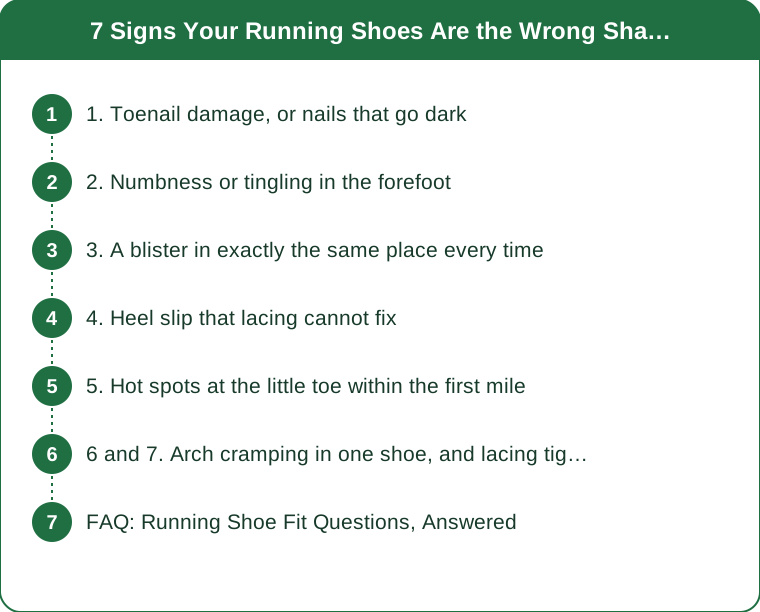
1. Toenail damage, or nails that go dark
The classic sign, and it is almost never about length.
Toenail bruising - subungual haematoma - happens when the toe repeatedly contacts the front or top of the shoe. People assume the shoe is too short, buy a half size up, and the problem often persists because the actual issue was the toe box height or the foot sliding forward.
The foot slides forward when the midfoot is not held. If the shoe is too voluminous through the middle, or the lacing cannot achieve a secure midfoot hold, then every downhill step and every stop lets the foot travel forward into the front of the shoe. Adding length gives the foot more room to travel.
A low toe box catches the nail from above rather than the front, which produces damage on the top of the nail and is common in people with a longer second toe or any degree of hammer toe.
The test: stand up in the shoe, unlaced, and slide your foot fully forward. You should be able to fit a finger behind the heel. Then lace normally and check whether your toes have vertical room - press down over the longest toe and feel for space. If length is fine but the nail is still bruising, the problem is midfoot hold or toe box height, and neither of those is fixed by a bigger size.
2. Numbness or tingling in the forefoot
This one people tolerate for far too long, often assuming it is normal on longer runs.
The usual cause is forefoot compression - a toe box narrower than the foot’s natural splay. The foot spreads under load, and it spreads more as a run progresses because it swells. A toe box that fits at the start can be genuinely compressive at mile six.
Compression across the metatarsals can irritate the nerves running between them, producing numbness, tingling, or burning that typically affects the third and fourth toes. It usually resolves within minutes of taking the shoe off, which is precisely why people dismiss it.
Lacing contributes. A tight lace over the top of the forefoot compresses from above, and many people tighten there specifically because their heel is slipping - which is solving one problem by creating another.
What to try: a shoe with a genuinely wider toe box, not a wide-fitting version of the same last, which usually widens the midfoot rather than the toes. Skip the lowest eyelet if the pressure is over the top of the foot. And go up in width rather than length.
Persistent numbness, or numbness that does not resolve after a run, warrants assessment by a healthcare professional rather than continued experimentation. This is general information, not medical advice.
3. A blister in exactly the same place every time
Random blisters are a friction and moisture problem. A blister that appears in the identical spot on every long run is a shape problem, and the location tells you which one.
Little toe, outer edge: the toe box is too narrow or too tapered. Very common, because a lot of lasts taper sharply toward the outside while human feet mostly do not.
Big toe, inner edge: the same issue on the other side, or a last with a straighter inside line than your foot.
Back of the heel: heel counter shape mismatch, or heel slip causing repeated up-and-down movement. If it is high on the heel, the collar height is wrong for you.
Under the ball of the foot: the foot is moving forward and back inside the shoe, which points at midfoot hold again.
Arch, medial side: often a mismatch between where the shoe’s arch support sits and where your arch actually is - a shape issue that no amount of breaking in resolves.
The principle worth holding onto: repeated location means repeated mechanical cause. Blister plasters treat the symptom competently and change nothing about why it keeps happening in that specific square centimetre.

4. Heel slip that lacing cannot fix
You lace tighter. It helps a bit, and now the top of your foot hurts.
Heel slip usually means the heel counter is wider than your heel, which is extremely common in people with narrow heels and a broader forefoot - a foot shape that a large proportion of shoes are simply not built for, because most lasts assume the heel and forefoot are proportional.
The standard advice is a runner’s loop or heel lock lacing, using the top extra eyelet to create a cinch around the ankle. It genuinely works and is worth learning. But if you need it on every run and it still slips, the shoe shape is wrong.
The compensation cascade is the real cost. Heel slipping leads to tighter lacing, which leads to forefoot compression, which leads to numbness and top-of-foot pain. Two of the other items on this list are frequently downstream of this one, which is why heel fit deserves more attention than it usually gets.
What to look for instead: brands and models built on narrower-heel lasts, a more structured heel counter, and shoes with a genuine gap between forefoot and heel proportions. This is one of the clearest cases where the fix is a different model rather than a different size.
5. Hot spots at the little toe within the first mile
A hot spot appearing early is diagnostic in a way a late one is not. Late-run hot spots can be about swelling, moisture, or sock choice. First-mile hot spots mean the shape is wrong before any of those variables have had time to matter.
The little toe is where it happens most, because the outside edge of a shoe’s last is where the biggest divergence between shoe shape and foot shape occurs. Many running shoes taper the outside of the toe box significantly, which suits a foot whose longest point is the big toe and pinches a foot whose forefoot is squarer.
A useful check: stand on a sheet of paper and trace your foot, then remove the insole from the shoe and place it over the tracing. If your tracing is wider than the insole anywhere, particularly at the forefoot, that is exactly where the pressure is coming from. This five-minute test tells you more than any amount of in-store walking.
The insole test also catches the opposite problem - an insole substantially wider than your foot means your foot has room to slide sideways, which produces its own instability and blistering.
6 and 7. Arch cramping in one shoe, and lacing tighter than feels right
6. Arch cramping or foot fatigue that is worse in one shoe
If one pair reliably produces arch cramping or a tired, achy foot and another pair does not, the difference is usually the shape of the footbed and where the shoe’s support sits.
Built-in arch support is placed according to an assumed arch position and height. If your arch is longer, shorter, higher, or lower than the assumption, the support pushes in the wrong place - which the foot resists, and sustained resistance is what cramping is.
Instep height matters here too. A shoe with a low instep volume on a foot with a high arch compresses the top of the midfoot, which restricts the natural flattening of the arch under load. That restriction is felt as fatigue rather than pain, which is why people rarely identify the cause.
The diagnostic: remove the insole and run in the shoe without it for a short easy run. If the cramping reduces noticeably, the footbed shape is a factor and a flat aftermarket insole may resolve it entirely for the cost of a coffee.
And the honest caveat: persistent arch pain, pain first thing in the morning on standing, or pain that worsens over weeks needs proper assessment rather than shoe swapping. This is general information, not medical advice.
7. You have to lace it tighter than feels comfortable
This is the summary sign, and the one worth acting on fastest.
A correctly shaped shoe holds the foot with moderate lacing. If you are pulling the laces hard enough that you think about them during a run, the shoe is not holding your foot with its shape, and you are asking the laces to do a job the last should be doing.
Over-lacing produces top-of-foot pressure, restricted forefoot splay, reduced circulation, and in some cases irritation of the tendons running across the top of the foot. It is a compensation, and compensations have costs.
The check: lace to a comfortable, moderate tension. Walk. Then jog twenty steps. If the heel lifts or the foot rolls inside the shoe at that tension, the volume or shape is wrong for you.
What actually solves it: a shoe with a lower volume through the midfoot if your foot is flatter, a higher volume if your instep is high, and a heel counter matched to your heel width. These are last characteristics, and the practical route to finding them is trying several brands rather than several sizes within one brand - lasts vary far more between brands than sizes vary within one.
And one habit worth adopting: shop for shoes in the afternoon or after a walk, when your feet are at their largest. Morning fitting is how people end up with shoes that are correct for a foot they only have for two hours a day.
FAQ: Running Shoe Fit Questions, Answered
How do I know if my running shoes are the wrong shape?
Look for problems that repeat in the same location - a blister in the identical spot, bruising on the same toenail, numbness in the same toes, or heel slip that lacing cannot fix. Repeated location indicates a mechanical cause, which is shape rather than size.
Should I buy running shoes half a size bigger?
Only if length is genuinely the problem, which it usually is not. Extra length gives the foot more room to slide forward, which can worsen toenail damage. Check width, toe box height, midfoot volume, and heel width before changing length at all.
What is the insole test for shoe fit?
Trace your bare foot on paper, then remove the insole from the shoe and lay it over the tracing. Anywhere your tracing extends beyond the insole - most often the forefoot and little toe - is a spot where the shoe is compressing your foot. It takes five minutes and is more informative than walking around a shop.
When should I see a professional about foot pain?
If numbness persists after a run, if arch pain is worst on first standing in the morning, if pain worsens over weeks despite changing shoes, or if there is swelling, deformity, or any pain sharp enough to change how you walk. This is general information, not medical advice.
TL;DR:
- Shoes are built on lasts, and lasts vary far more between brands than sizes do within one.
- Repeated-location problems are shape problems; random ones are friction problems.
- Heel slip causes tight lacing, which causes forefoot numbness - fix the heel first.
- The paper tracing versus insole test takes five minutes and finds most shape mismatches.
- Fit shoes in the afternoon, when your feet are their actual working size.
Half a size up is the fix for one problem out of seven. The other six live in dimensions the box does not print.
Keep Reading
This article is for general informational purposes only and is not medical advice. Always consult a qualified health professional for guidance specific to you.