7 Signs Your Shoes Are the Wrong Shape for Your Feet
Quick Answer: Size is one number; shape is at least four - toe box width, toe box height, midfoot volume, and heel width. A shoe can be the correct length and still be the wrong shape, and the symptoms are specific: numbness in the toes, calluses in particular spots, a foot that spills over the sole edge, and toenail problems that keep coming back. Going up a size makes some of these worse, because a longer shoe puts the flex point in the wrong place.
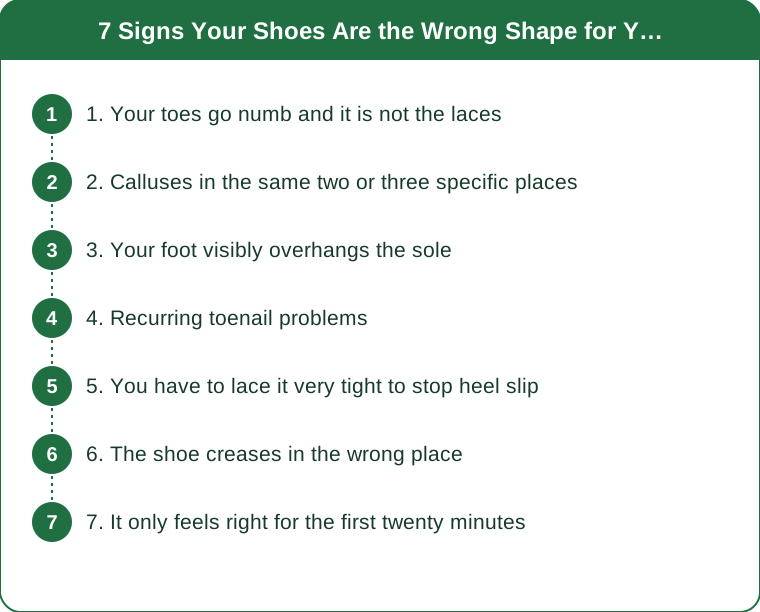
Seven signs, and what each one is actually telling you.

1. Your toes go numb and it is not the laces
The most common shape complaint and the most commonly misdiagnosed.
Numbness across the ball of the foot or in the toes is usually compression of the digital nerves that run between the metatarsal heads. When a toe box is narrower than the widest part of your foot, the metatarsals are squeezed together and the nerve between them gets pinched.
The distinguishing detail: lace-related numbness appears on the top of the foot and resolves the moment you loosen the laces. Shape-related numbness appears in the toes, often the third and fourth, and does not resolve with lacing changes.
It typically starts 15 to 30 minutes into activity, because the foot swells during exercise. Feet expand by roughly half a size over a day and more during activity, so a shoe that fits at rest can compress once you are warm.
What it points to: you need a wider toe box, not a longer shoe. Going up a size gives you more length, marginally more width, and a flex point that now sits behind your toe joints - which introduces a new problem while only partly solving this one.
The test: stand on a piece of paper, trace your foot, then place the shoe’s insole on top of the tracing. If your tracing is wider than the insole at the ball of the foot, the shape is wrong regardless of what the size label says. Almost nobody does this and it takes two minutes.
2. Calluses in the same two or three specific places
Calluses are a map of where the shoe is applying pressure, and the location is diagnostic.
Along the outside of the big toe or the inside of the little toe: the toe box is too narrow. These are the classic shape calluses and they are the body responding to sustained lateral pressure.
On the tops of the toes, especially the second and third: the toe box is too shallow. This is a vertical dimension that almost no one considers, and it varies as much between shoe models as width does. If your toes are hitting the upper, the box is low.
Under the ball of the foot, in one concentrated spot: usually a load distribution problem, sometimes from a shoe that is too stiff in the wrong place.
On the back of the heel: heel counter shape mismatch, or a heel that is too wide for you and allowing movement.
The useful thing about callus mapping is that it is cumulative evidence. A single blister could be a bad sock or a long day. A callus that has been in the same place for two years is telling you about a persistent geometric mismatch, and it will not resolve until the geometry changes.
A practical exercise: look at your bare feet, note where the thickened skin is, and then look at the corresponding spot on the inside of your shoe. There is usually a visible wear mark in exactly the same place.
3. Your foot visibly overhangs the sole
One of the few signs you can check with a photograph, and one of the most reliable.
Stand normally, weight even, and have someone photograph your feet in the shoes from directly behind and from the front. Look at whether the soft tissue of your foot spills out over the edge of the midsole at the widest point.
Some overhang in a very flexible upper is not necessarily a problem. Significant overhang means the platform underneath you is narrower than your foot, which has consequences beyond comfort - you have less base of support for lateral movement, and the upper is doing structural work it was not designed for.
This is particularly relevant for lateral activities. In a straight-line run the foot mostly loads front to back. In tennis, a court class, or any lateral training, the foot loads sideways against the upper, and a shoe narrower than your foot will roll off the platform under that load.
What it points to: a wider last, not a longer shoe. Many brands offer the same model in a wide fitting, and increasingly some offer genuinely foot-shaped lasts with a toe box that is widest at the toes rather than tapering.
Worth knowing: most conventional athletic shoes are widest at the ball of the foot and taper toward the toe. Most human feet are widest at the toes. That mismatch is structural to the category, which is why so many people are in the wrong shape without ever having chosen badly.

4. Recurring toenail problems
Black toenails, thickened nails, and repeated ingrown nails are usually a shape signal rather than a hygiene one.
Black toenails come from repeated impact of the nail against the front or top of the shoe. In runners this is classically attributed to a shoe that is too short, but it is at least as often a toe box that is too shallow - the nail is hitting the upper vertically rather than the end horizontally.
Ingrown nails, particularly on the big toe, are frequently caused by lateral compression pushing the nail edge into the surrounding tissue over months. Narrow toe boxes and pointed shoes are the standard mechanism.
Thickened nails can result from chronic low-grade trauma, which a poorly-shaped shoe delivers thousands of times per session.
The timing question that sorts this out: does it happen with one specific pair? Nail problems that track a particular shoe are almost certainly geometric. Nail problems present across every shoe you own suggest either a common shape preference in what you buy, or something worth having looked at by a podiatrist.
The conventional length check - a thumb’s width between the longest toe and the end - remains useful, but it should be done standing, at the end of the day, in the socks you will wear. Sitting, in the morning, in thin socks is the state in which a too-small shoe feels fine.
5. You have to lace it very tight to stop heel slip
This is a midfoot volume and heel width problem, and the tight lacing is a workaround that creates a second issue.
Heel slip happens when the heel counter is wider than your heel, so there is not enough contact to hold it. The instinctive fix is to lace tighter, which pulls the foot back and down into the heel cup.
That works, partially. It also compresses the top of the midfoot, which is where the nerves and tendons run, and it is a common cause of the top-of-foot numbness and tendon irritation that people then blame on the shoe being too small.
The underlying variable is volume - how much three-dimensional space the shoe encloses - which is entirely independent of length and width. A low-volume foot in a high-volume shoe requires cranking the laces to take up space. A high-volume foot in a low-volume shoe feels tight on top even when the length and width are right.
Signs you are compensating for volume: a very large gap between the lace eyelets when tightened, needing to use the last eyelet and a heel-lock lacing pattern on every shoe, or the tongue sliding to one side.
What helps: a shoe with a narrower heel-to-forefoot ratio, a different lacing structure, or a thicker insole to take up volume from below rather than pulling down from above. Insole swapping is the cheapest and most underused fix for this specific problem.
6. The shoe creases in the wrong place
A visible diagnostic that appears within a few weeks of wear.
When you push off, the shoe should bend where your foot bends - at the metatarsophalangeal joints, the ball of the foot. A shoe whose flex point matches your foot creases in a clean line across that point.
If the crease is too far forward, the shoe is too long for you and is bending past your joint, which means the shoe is fighting your foot on every step. This is the specific problem created by sizing up to solve a width issue.
If the crease is diagonal and deep on one side, the shoe’s flex point does not match your foot’s angle. Feet vary in the angle of the metatarsal line, and a shoe built for a different angle will crease asymmetrically and often produce a callus on the side that takes more load.
If there is no clear crease but the upper is bunching, the shoe is too stiff for the movement you are using it for.
Check it after about two weeks of regular wear, standing on tiptoe. The crease line should sit directly over the widest part of the sole and directly under the ball of your foot. It is one of the more objective fit tests available and it costs nothing.
7. It only feels right for the first twenty minutes
The delayed-onset complaint, and the one that makes shop fitting so unreliable.
Feet swell during activity - increased blood flow, minor fluid shift, and heat all contribute. The magnitude is meaningful: feet can increase in volume by several percent during sustained exercise, and more in hot weather. In late August that effect is at its annual maximum.
A shoe with adequate volume accommodates the swelling. A shoe that is already at its limit at rest becomes genuinely tight, and that is when the numbness, the hot spots, and the toe pressure arrive.
This is why the standard advice to shop for shoes in the afternoon is well founded, and why trying them on for two minutes on a carpeted shop floor tells you comparatively little.
What to do instead:
- Try shoes at the end of the day, or right after activity.
- Wear the socks you will actually train in. Sock thickness alone can account for a third of a size in effective volume.
- Walk or jog for at least five minutes in the shop, and use a treadmill if there is one.
- Check the return policy for worn shoes. Many specialist retailers now allow returns after real use, which is by far the most reliable way to test.
If a shoe is perfect at minute two and wrong at minute thirty, the shape is marginal rather than adequate - and marginal at rest means wrong under load.
TL;DR:
- Size is length; shape is toe box width, toe box height, midfoot volume, and heel width - and only one of those is on the label.
- Toe numbness that laces do not fix means a narrow toe box; going up a size moves the flex point and adds a new problem.
- Callus locations are a pressure map - outside of the big toe means narrow, tops of the toes means shallow.
- Recurring black or ingrown toenails are usually geometric, especially if they track one specific pair.
- Heel slip fixed by very tight lacing is a volume problem; try a thicker insole before cranking the laces.
- Check where the shoe creases after two weeks - it should sit exactly over the ball of your foot.
Trace your foot on paper and put the insole on top of it. Two minutes, and it settles the width question permanently. This is general information, not medical advice.
Keep Reading
This article is for general informational purposes only and is not medical advice. Always consult a qualified health professional for guidance specific to you.