7 Reasons Your Toes Go Numb During a Workout (And What Fixes Each One)
Quick Answer: Numb toes during exercise most often come down to shoes laced too tightly across the top of the foot, a toe box that’s too narrow for how your foot swells during activity, or a running form issue that puts repeated pressure on the same nerve — all three are identifiable and fixable without needing to just accept numbness as normal.
Occasional mild numbness that resolves quickly after stopping is usually benign, but frequent or persistent numbness is worth actually tracking down rather than working around.

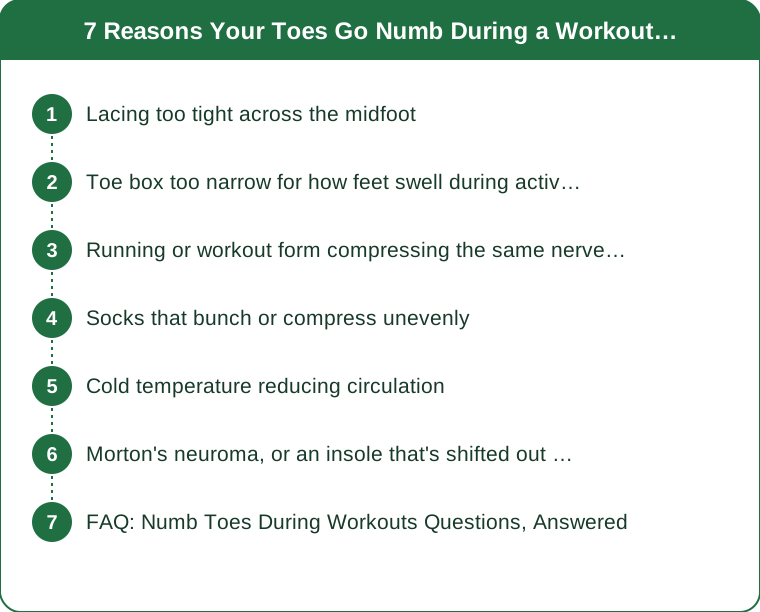
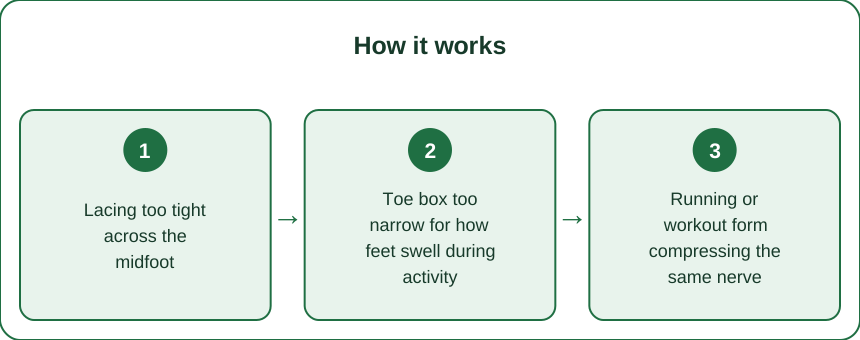
Lacing too tight across the midfoot
The most common cause by far — lacing that’s snug across the top of the foot (the instep) can compress the nerves running across that area, and simply loosening the laces in that specific section (skip-lacing over the tightest point) resolves it for a large share of people without changing shoes at all.
Toe box too narrow for how feet swell during activity
Feet swell measurably during sustained activity, and a toe box that fit fine at rest can become genuinely restrictive 20-30 minutes into a run or class — trying shoes on later in the day (when feet are naturally slightly more swollen) gives a more accurate read on whether the toe box has enough room for activity.
Running or workout form compressing the same nerve repeatedly
A gait pattern that puts consistent pressure on one area (common with certain foot strike patterns) can cause numbness tied specifically to that repetitive compression — a gait analysis at a specialty running store can identify this when shoe fit alone doesn’t explain persistent numbness.

Socks that bunch or compress unevenly
Socks that shift or bunch during a workout can create localized pressure points independent of the shoe itself — moisture-wicking athletic socks with a snug, consistent fit (rather than loose crew socks that migrate) reduce this as a contributing factor.
Cold temperature reducing circulation
In cold-weather workouts, reduced blood flow to extremities is a normal physiological response that can cause numbness independent of shoe fit — this typically resolves as the body warms up during activity and isn’t usually a fit issue at all, though persistent cold-related numbness that doesn’t improve is worth checking with a doctor.
Morton’s neuroma, or an insole that’s shifted out of position
Numbness concentrated specifically between the third and fourth toes, especially with a sensation of a lump or pebble in the shoe, can indicate Morton’s neuroma, a nerve condition that benefits from a wider toe box and, in persistent cases, professional evaluation rather than shoe adjustments alone. Separately, a slipped insole or an orthotic that’s not properly seated can create uneven pressure distribution that wasn’t present when the shoe was first fitted — periodically checking that insoles sit flat and centered is a simple check that’s easy to overlook.
FAQ: Numb Toes During Workouts Questions, Answered
Is any toe numbness during exercise cause for concern?
Occasional, mild numbness that resolves within a few minutes of finishing a workout is common and usually not concerning, but numbness that’s frequent, persistent after stopping, or accompanied by pain or color change warrants a conversation with a doctor.
Should I just size up my shoes if my toes go numb?
Not necessarily first — loosening laces across the midfoot solves the issue for many people without needing a different shoe size at all, so it’s worth trying before assuming a sizing problem.
Does numbness during workouts usually indicate a serious nerve problem?
Most of the time, no — mechanical causes (lacing, toe box fit, socks) explain the large majority of cases, and serious nerve conditions are a less common cause, though persistent or worsening numbness is still worth having evaluated.
TL;DR:
- Tight midfoot lacing is the single most common cause and the easiest to fix
- A toe box too narrow for activity-related foot swelling is a close second
- Persistent numbness in one specific spot (between toes 3-4) may need professional evaluation
- Cold-related numbness during winter workouts is usually a normal, separate cause
Toe numbness has identifiable causes worth tracking down — it’s a fixable fit or form issue far more often than something to just push through.
Keep Reading
This article is for general informational purposes only and is not medical advice. Always consult a qualified health professional for guidance specific to you.